
The risks, explained without the marketing
This page reads the risk position as a quantitative matter. It sets the PwC 2023 estimate of 3 million to 4 million UK adults using offshore operators, and the 79 per cent concentration of problem gamblers on unlicensed sites, alongside the specific consumer protections that are absent when a stake leaves the UKGC frame. The point is a defensible size for each gap, not a warning tone.
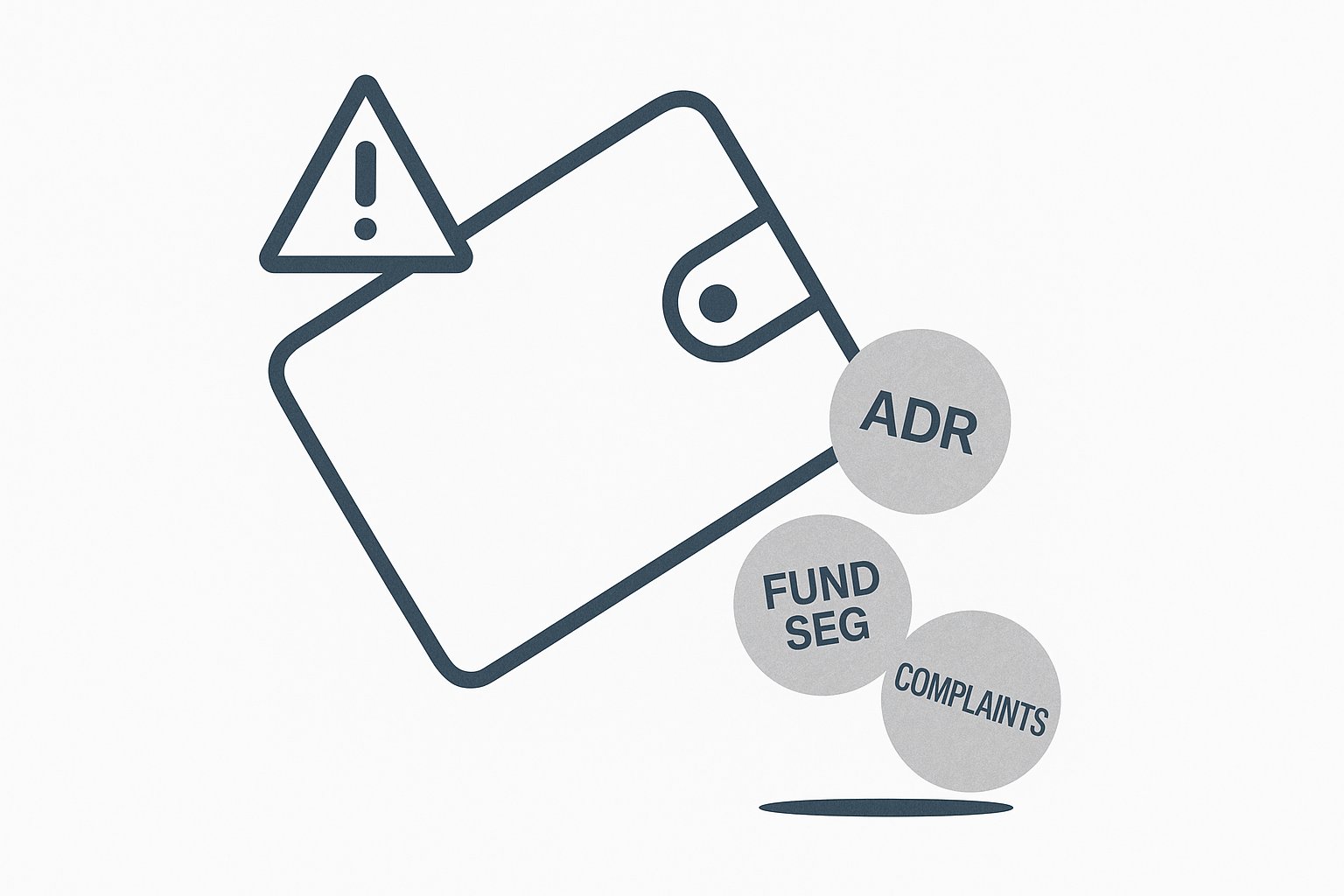
No UKGC oversight, what that means day to day
UKGC oversight of a licensed operator is a continuous exercise. It includes annual regulatory returns, quarterly complaint intake, targeted compliance assessments, thematic reviews on identified risk areas, sanctions where breaches are found, and public statements that name the operator and describe the finding. In the 2025 enforcement return alone, fines against UKGC licensees included Spreadex at 2.0 million pounds, AG Communications at 1.4 million pounds and Corbett Bookmakers at 686,000 pounds. Those figures are visible because the supervisory chain is public. The consumer of a licensed operator is not required to take the operator's compliance on trust, the record is on the Commission's website.
On the offshore side, the equivalent record does not exist in a form the UK consumer can read. Curacao's LOK 2024 register is more transparent than the previous master-licence structure, and the Malta Gaming Authority publishes some enforcement material, but neither approaches the depth or the regularity of the UKGC's public record. In practical day-to-day terms, this changes what a customer can find out before they deposit. On a UKGC licensee, the compliance history is searchable in a way that produces useful signal. On a non-UKGC operator, a search of the equivalent depth typically returns marketing copy and third-party review content of uncertain provenance rather than an audit trail. The absence of the supervisory record is the first, quiet risk. It is not the loudest, but it shapes every other risk on this page.
02No fund segregation guarantee
Fund segregation is a formal condition of a UKGC operating licence at higher rating levels, and every UKGC licensee is required to describe the level of protection it offers to customer funds in a rating disclosure on its site. The rating scale runs from "not protected" through "medium protection" to "high protection", with the top rating requiring customer funds to be held in trust in a separate account with a legal structure that keeps them outside the operator's own insolvency estate. A meaningful share of UKGC licensees hold the medium rating and a subset hold the high rating, which means that in the event of insolvency, customer balances are treated as trust property rather than as unsecured claims against a failed company.
Non-UKGC operators are not bound by that condition. Some publish an equivalent statement voluntarily, some describe their arrangements in generic terms, and some make no statement at all. Where the operator sits in a jurisdiction whose insolvency law does not recognise the concept of segregated trust accounts for customer funds, even a voluntary statement provides limited practical assurance in the event of operator failure. This is not a hypothetical concern. The offshore market has a longer failure tail than the licensed market, in the sense that smaller unlicensed operators cease trading more frequently and with less orderly wind-down. Where that happens, stored balances tend to be lost. The fund-segregation gap is the second concrete difference between the two markets.
A closer look
Two operational details matter. First, the fund-segregation rating on a UKGC site is required to be displayed in a prominent place, typically in the site's terms of use or in a dedicated responsible-gambling page. If a UK adult can read the rating, they know where the operator sits on the scale. Second, the rating is an operator-level statement subject to regulatory oversight, so a false or misleading rating declaration is itself a licence breach and would appear in the UKGC public statement record if enforced. Neither of these mechanisms is available to a customer of a non-UKGC operator, and this is what a numerate reading of the topic really means, the difference is not a claim about honesty, it is a difference in the auditability of the claim.
03No mandatory ADR body
The absence of a mandatory Alternative Dispute Resolution body is the risk most often understated in general coverage. A UKGC-licensed operator must appoint an approved ADR provider whose decisions bind the operator up to a defined monetary threshold, whose annual data is public, and which sits inside the ADR for Consumer Disputes framework in UK statutory instruments. That is not a marketing promise, it is a piece of law. It gives the consumer a defined complaint pathway, a public dataset on outcomes, and an independent adjudicator with a rulebook. The mechanism has known limits, in particular around the definition of eligible disputes and around resolution speed, but it exists and it delivers real outcomes.
The consumer of an unlicensed operator has none of that mechanism. Where a dispute arises, the operator's internal complaints process is the only route available at the operator side, and that process is not subject to independent adjudication or public reporting. The customer's remaining options are the card scheme chargeback rules if the deposit was by card and the ground of dispute is eligible, the Financial Ombudsman Service jurisdiction over UK-authorised payment intermediaries where relevant, and a civil claim in the operator's home jurisdiction where the dispute is large enough to justify it. Anecdotal complaint records on consumer forums suggest a withdrawal-dispute prevalence materially higher than in the licensed market, though those records are self-selected and cannot be treated as a representative sample.
04Offshore licensing landscape after Curacao LOK 2024
The Landsverordening op de Kansspelen came into force on 24 December 2024 and reshaped the Curacao licensing landscape. It ended the four-master-licence structure that had operated since 1996, installed the Curacao Gaming Authority as a single-tier regulator, and introduced a public register of licensees together with published licensing conditions and an inspection remit. On paper the reform brought Curacao closer to a European-style regulatory arrangement, and it did produce a more transparent register than the pre-2024 arrangement. Six-month figures released by the CGA in early 2026 record a lower headline count of active licensees than the aggregate under the earlier master-licence system, which is consistent with the transition and does not by itself indicate operational failure.
What LOK 2024 does not do is deliver equivalence with the UKGC. The CGA's inspection capacity is smaller, its complaint handling volume is smaller, its published enforcement outcomes are fewer, and it does not operate an ADR framework of the kind the UKGC requires. Its licence conditions carry no fund-segregation trust requirement at the UKGC top rating level, no mandatory ADR appointment, no Statutory Levy participation and no CAP/BCAP-equivalent marketing code applied through an independent regulator. The reform is real and material, but it is a transparency upgrade at the licence layer. The supervisory layer that surrounds a UKGC licence, and that produces the protections listed on the licensed side, is not replicated by the current CGA capacity.
Key points
- PwC 2023: 3 million to 4 million UK adults using offshore operators, 5 per cent to 11 per cent of remote market stake share
- PwC 2023: around 79 per cent of PGSI-identified problem gamblers estimated to have used an unlicensed operator within the study window
- UKGC 2024-25 enforcement: 770-plus cease-and-desist notices, 64,000 URL removals, 264 domain removals
- 2025 UKGC fines against licensees: Spreadex 2.0 million pounds, AG Communications 1.4 million pounds, Corbett Bookmakers 686,000 pounds
Consumer protection matrix
| Protection | UKGC-licensed operator | Non-UKGC operator |
|---|---|---|
| UKGC supervisory oversight | Continuous, public record | None |
| Mandatory ADR body | Required, approved, public data | Not required |
| Segregated customer funds | Rated, disclosed, audited | Not required |
| UK affordability checks | Tiered framework, in force 2025 | Not required |
| GamStop integration | Mandatory licence condition | Not required |
| Online slot stake cap | 2 pounds under-25, up to 15 pounds 25+ | Not required |
| CAP and BCAP marketing codes | Enforced by ASA | Out of ASA scope in practice |
| Statutory Levy contribution | 0.1 to 1.1 per cent of GGY from 6 April 2025 | Not a levy-payer |
| Complaint route to regulator | Intake to UKGC, ADR escalation | Not available |
| UK income tax on winnings | Not chargeable to individual | Not chargeable to individual |
Anjouan, MGA, Gibraltar, how they compare
Outside Curacao the three most visible jurisdictions in the offshore-facing market are the Malta Gaming Authority, the Gibraltar Regulatory Authority and, in the newer entrant category, the Autonomous Island of Anjouan under its remote gaming licensing framework. Each has a distinct profile. The MGA runs a formal European-style register, publishes an enforcement calendar, imposes a segregation requirement and operates a player protection directorate. Gibraltar is a mature jurisdiction whose licensees have historically served the UK market under long-standing arrangements, though the post-Brexit passporting position ended dual passport arrangements and the practical operational base of many Gibraltar-licensed brands has shifted. Anjouan is the newest tier and offers a lower entry point, with a less developed supervisory record.
For the UK reader the relative ranking of the three is less important than the position of all three relative to the UKGC. None of the three matches the UKGC on the full stack of protections listed in the matrix above. Each covers a subset. Any framing that reads a jurisdiction name on a footer badge as equivalent to a UKGC licence misreads the picture. A Malta Gaming Authority licence, on any honest analysis, provides more consumer protection than an Anjouan licence, and both provide less than a UKGC licence. That is the reading the data supports. It is not a moral point about the jurisdictions, it is a supervisory-depth point.
A closer look
One useful diagnostic is to check what a jurisdiction publishes about its own enforcement activity. A regulator with a mature supervisory function publishes settlement summaries, public statements, licence-revocation records and an annual enforcement report. A regulator whose supervisory function is nominal publishes very little of that, and what it does publish is often descriptive of the licensing regime rather than of enforcement action against specific licensees. Applied to the offshore jurisdictions, this diagnostic separates the mature regulators from the developing ones with reasonable reliability. The UK reader who is doing due diligence on any offshore operator is better served by looking at the regulator's public enforcement record than at the operator's own compliance narrative.
06Payment friction that is only growing
The payment side of the offshore market has become materially harder in the two years to August 2026. The 2025 joint taskforce between the Visa network, the Mastercard network and the UKGC tightened enforcement on the merchant category code 7995, which is the card scheme code for gambling transactions, and reduced the effectiveness of routing tactics that some offshore acquirers had been using through 2023 and early 2024. The five largest UK current-account providers now offer a voluntary in-app gambling switch that blocks MCC 7995 transactions on debit cards, and in the case of Monzo, Starling and Barclays on credit cards too. HSBC, Lloyds and the smaller providers have parallel arrangements. Where the switch is enabled, offshore card deposits are declined at the bank's own filter, before they reach the operator's acquirer.
Crypto rails are frequently marketed as an anonymous alternative, and they are not. Fifth Money Laundering Directive obligations in the UK, together with the Financial Conduct Authority's cryptoasset registration regime, mean that a UK-facing exchange applies Know Your Customer checks at the fiat on-ramp and off-ramp. The identity capture happens at the exchange, not at the operator, so from a UK legal and payments-friction perspective the transaction is still identifiable and still auditable. Add the AML delay window that some UK banks apply to first-time gambling-related outbound transfers, twenty-four to seventy-two hours in practice, and the practical experience of an offshore deposit is slower, more visible and more frequently blocked than the marketing tends to imply.
What happens to your ID documents
ID documents shared with an offshore operator sit in a data-protection regime that is often not equivalent to UK GDPR. Where the operator sits inside the European Economic Area, GDPR-equivalent obligations apply and the Information Commissioner's Office maintains co-operation arrangements with the national supervisory authority. Where the operator sits outside the EEA, the data-protection regime is defined by the operator's home jurisdiction and can vary widely. A Curacao-based operator, an Anjouan-based operator and a Panama-based operator all have different national frameworks, and the practical consequences for data subject rights, breach notification obligations and cross-border transfer restrictions are correspondingly different.
The specific risks on ID document handling are two. First, the retention period may be longer than the equivalent period at a UKGC-licensed operator, because the operator's home law defines the retention requirement rather than UK law. Second, in the event that the operator ceases trading, the fate of the retained ID data depends on the receiver, if any, appointed in the operator's home jurisdiction. UK GDPR breach-notification obligations do not automatically travel with the data, and a UK data subject may find that a breach affecting their documents is neither notified to them nor reported to the Information Commissioner's Office in the way UK data protection law would require of a UK-established data controller. Verification friction and data-protection friction sit close together in the offshore experience.
08Practical harm-reduction if a deposit has already gone
The starting point, if a deposit has already been placed and the person is worried, is the National Gambling Helpline on 0808 8020 133. It is free, it is confidential and it is open every hour of every day. A trained adviser can talk through the situation, refer into a structured brief conversation, refer to a specialist counsellor within the National Gambling Support Network, refer to the National Health Service specialist clinic pathway or refer to a family-focused pathway through GamAnon. There is no requirement to have decided in advance which of those routes is right for the person. The call itself is the first step of the decision, and it does not have to lead anywhere the caller is not ready to go.
A second step, particularly for readers whose worry has been building over several deposits rather than a single one, is a written baseline. A short handwritten record of the deposit dates, amounts, operator names, payment methods used and any communications received produces a defensible reference for later conversations with the helpline, with a general practitioner, with a debt-advice charity such as StepChange or National Debtline, or with an NHS specialist clinic if a referral becomes appropriate. It also produces the record a household member or partner needs if the person is choosing to bring somebody else into the picture. The record does not have to be complete, it does not have to be pretty, and it does not have to be shared. It only has to exist. Practitioners who work in this field consistently describe the moment a person moves from remembered figures to written ones as the point at which the money layer becomes tractable. That step is not by itself a treatment, but it removes a friction that otherwise slows every other step, and it costs nothing.
On the money side, the immediate steps are practical rather than dramatic. Contact the card issuer within the scheme chargeback window if the deposit is disputed on eligible grounds. Consider enabling the voluntary card gambling switch at the bank if it is not already enabled, which applies within minutes on any of the five largest UK current-account providers. Where an electronic money issuer was used, contact the issuer through its regulated complaints process. Where a bank has declined a transfer or has raised a Suspicious Activity Report, wait for the process to complete rather than attempting workarounds. None of these steps guarantees recovery, and this page does not present them as a recovery pathway. They are the reasonable, defensible actions available to a UK adult who has decided that this deposit was not what they intended.
Read next
- GamStop explained, the scheme, the periods, the checks
- The legal position for UK players outside GamStop
- Payments and checks, banks, cards, crypto, KYC
- Coming off GamStop, the official route
- Getting support, helplines, clinics, family, money
Sources and verification
Grey-market population and concentration figures are drawn from the PwC report commissioned for the Betting and Gaming Council in 2023 as reproduced in the UKGC public commentary on unlicensed operators at gamblingcommission.gov.uk. Enforcement volumes reproduce the Commission's 2024-25 return. GamStop mechanism references are consistent with gamstop.co.uk. Statutory Levy figures follow the Gambling Levy Regulations 2025 as commenced 6 April 2025. Last checked 5 August 2026.
Frequently asked questions
How many UK adults are estimated to use offshore gambling sites
The PwC report commissioned for the Betting and Gaming Council in 2023 placed the UK population using unlicensed offshore operators in the range of 3 million to 4 million adults, corresponding to between 5 per cent and 11 per cent of remote market stake share on the study's central estimates. The figures are grey-market projections rather than direct counts and their methodology has been contested, but they are the most cited quantitative baseline in the public domain and they anchor most subsequent discussion.
How concentrated is offshore play among people already experiencing gambling harm
The same PwC modelling recorded a concentration figure that has become the most cited number in this literature, in the region of 79 per cent of individuals identified as experiencing problem gambling on the PGSI scoring were estimated to have used an unlicensed offshore operator within the study window. The 79 per cent figure is a modelled share, not a survey count, and it carries an uncertainty band, but the direction of the concentration is consistent across supporting evidence.
What consumer protections are actually absent on a non-GamStop site
The material absences are the UKGC dispute route, the mandatory ADR framework, the segregated customer funds requirement, the UK affordability check regime, the CAP and BCAP marketing codes as applied to UK audiences, the Statutory Levy contribution to NHS treatment, and, in practice, GamStop integration. The consumer protection matrix section of this page presents each of these against its UKGC counterpart and marks the size of the gap on the available evidence.
Are Curacao-licensed operators safer since the LOK 2024 reform
The Landsverordening op de Kansspelen came into force on 24 December 2024, ending the four-master-licence system and installing the Curacao Gaming Authority as a single-tier regulator with a public register and stated enforcement policy. The register is more transparent than the arrangement it replaces, but the CGA's inspection capacity, complaint handling volume and enforcement outcomes are not equivalent to those of the UKGC. LOK 2024 improves transparency at the licence layer, it does not deliver equivalence at the supervisory layer.
If a deposit has already gone to an offshore site, what can I actually do
The best first step is to call the National Gambling Helpline on 0808 8020 133, which is free and open 24 hours a day. On the money side, contact the card issuer or the electronic money issuer within the scheme chargeback window if the deposit is disputed on eligible grounds, and consider enabling the voluntary gambling switch on your account if you have not done so already. Recovery from the offshore operator itself is theoretically available through civil claim in its jurisdiction and, in most cases, disproportionate to the sum at stake.
Talk to someone today
The National Gambling Helpline is free, confidential and open 24 hours a day, seven days a week.