
GamStop explained, the scheme, the periods, the checks
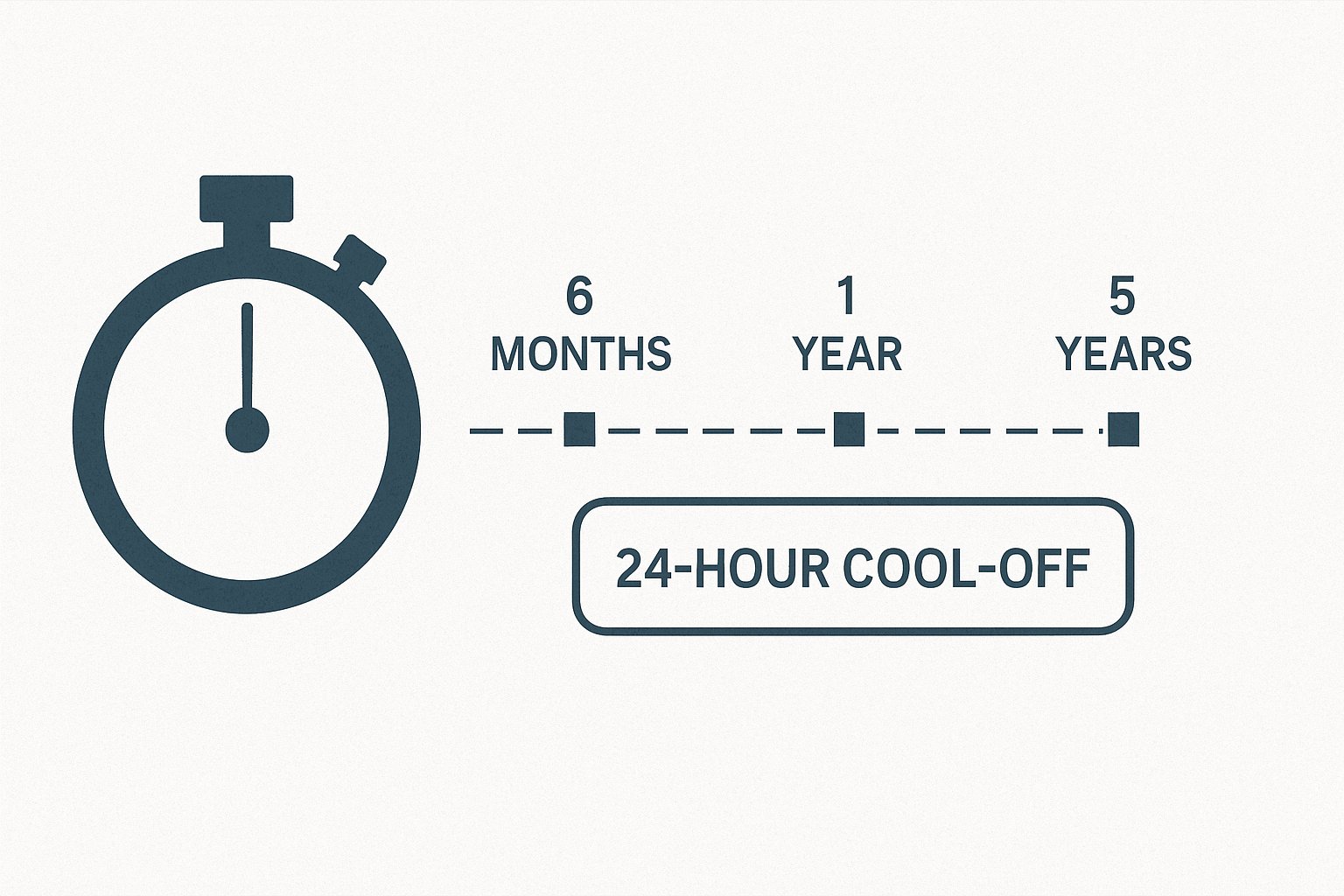
GamStop is a small piece of infrastructure with a very tight set of numbers around it. This page walks each one in turn, the three fixed-term options of six months, one year and five years, the twenty-four hour cool-off that follows expiry, the seven-year continuation that follows inaction, and the population of roughly 550,000 registrations that the scheme now records. The intention is a numerate description rather than a persuasive one.
What GamStop is, plainly
GamStop is the national online self-exclusion register for remote gambling in Great Britain. It is operated by the National Online Self-Exclusion Scheme Limited, a company limited by guarantee, funded through contributions from UKGC-licensed remote operators and formally endorsed by the UK Gambling Commission as the required self-exclusion mechanism for the licensed remote market. Registration is voluntary at the point a person joins the register, but the exclusion becomes binding on operators once it is active. That is the whole design in one sentence. A registrant enters a personal record, chooses a fixed-term period, and every operator that holds a UKGC remote licence is obliged, as a matter of licence condition, to refuse account opening and to close existing accounts belonging to that record for the duration of the period.
In population terms, the scheme's most recent annual figures place cumulative registrations above 550,000 unique individuals to the end of the last complete reporting year, with an annual intake in the region of 90,000 to 110,000 new registrants in recent cycles. That headline should not be read as a proxy for the total UK adult gambling population, or for the total number of UK adults experiencing gambling harm, because GamStop registration is a self-selecting act with its own dynamics. It is a count of the individuals who have chosen to enrol themselves in a formal self-exclusion process, which sits somewhere between the population that discusses gambling with a partner or a general practitioner and the smaller population that reaches a specialist treatment pathway. Read in that light, the number tells us the scheme is neither niche nor universal, it is a mid-scale intervention with a specific mechanism.
02The three periods, and what each commits you to
The scheme offers three fixed-term choices, six months, one year, and five years. There is no shorter option and no longer option. Once a period is confirmed at registration it is active on the licensed side within a short technical window, typically measured in hours rather than days, and the record then persists for the full length of the term selected. The design point that catches most first-time readers is that the term cannot be shortened once it is active. The published position on gamstop.co.uk is that a person who wishes to end an exclusion must wait until the fixed-term period runs its course, and then follow the removal process that starts with the twenty-four hour cool-off described further down this page.
The distribution across the three periods is not symmetric. Across the annual returns published by the scheme, the six-month option accounts for the largest share of new registrations, in the region of forty to fifty per cent depending on the year, the one-year option accounts for the middle share and the five-year option, though smaller in raw count, has grown as a proportion since 2021. That growth in the longer-term share is one of the more informative signals in the dataset. It suggests a subset of registrants using the scheme as a decisive multi-year commitment rather than a short pause, and it aligns with the pattern seen in the specialist clinical literature, where registrants who reach the National Health Service treatment pathway skew toward longer periods when they later re-engage with GamStop.
A closer look
Within each period band, the practical experience is broadly the same at the licensed side. All UKGC remote operators consult the register at account opening and periodically during the customer lifecycle. What differs is what the period asks of the registrant. A six-month period is often chosen as a first attempt at a reset, a way of stepping back without committing to a long horizon. A one-year period tends to correspond to a considered decision to break a pattern that has been visible over successive months. A five-year period is a very different act, and clinicians who work in the field treat it as the point at which the individual has moved from experimental self-management to an explicit long-term boundary. None of these are formal categories inside the scheme itself, they are how the data reads when it is broken out by cohort and observed across follow-up windows in the peer-reviewed literature.
03How the block reaches every UKGC-licensed site
The block is a licence-condition mechanism, not a network-level filter. Every UKGC-licensed remote operator is required by Social Responsibility Code Provision 3.5.5 of the Licence Conditions and Codes of Practice to participate in the multi-operator self-exclusion scheme that the UKGC endorses, which in practice is GamStop. The reference architecture is straightforward. GamStop maintains the register of individuals in active self-exclusion. Each licensed operator holds an integration that consults the register when a new account is created and when critical events occur on an existing account, and returns a refusal or a closure where the register matches. Operators are audited against the outcome, and the UKGC's own compliance and enforcement work in 2024 and 2025 recorded a small number of settlements against operators whose integration or process failed to enforce the block reliably.
Because the register is operator-side rather than device-side, the block reaches every licensed site whether the registrant uses a laptop, a phone, a shared computer or a device that has never touched the site before. It also survives changes of IP address, changes of email address where the underlying identity match still holds, and changes of card details. Where the scheme is limited, and this is the material point for the population of readers arriving on this site, is at the boundary of the UKGC-licensed market itself. Operators that hold no UKGC licence sit outside the licence-condition perimeter and are not obliged to consult the register. That is the structural reason a person in an active period can encounter an offshore site that does not decline registration, and it is where the rest of the network's pages take up the topic.
04What happens when your period ends
The end of a fixed-term period is not an automatic return to play. GamStop's own published wording on gamstop.co.uk describes a defined sequence. First, the period expires on the calendar date recorded at registration. Second, the licensed side of the market waits out the twenty-four hour cool-off described in the next section before it may accept an account from that individual. Third, the individual must actively contact GamStop to confirm the intention to end the exclusion. If the individual does not contact the scheme within the defined window after expiry, the exclusion continues for a further seven years by default, which is the auto-extension covered in section six. The sequence is deliberately dry. It is a set of gates rather than a single moment, and each gate is there because self-exclusion research had shown that a single gate produced too many impulsive returns.
Read as a dataset, the transitions at end-of-period show up in the scheme's annual return figures as three distinct flows. There is a flow of registrants who actively re-engage during the cool-off window and choose to return to the licensed side. There is a flow of registrants who actively re-engage and choose to register a follow-on period, which is a very common pattern for the five-year cohort. And there is a flow of registrants who take no action and continue in the auto-extension by default. The three flows differ in size year on year, but the pattern is stable, the largest single flow is the follow-on registration flow, not the return flow. That is the empirically supported reading of what end-of-period looks like in aggregate. It is not the reading that surrounding marketing material tends to imply.
Key points
- Cumulative registrations exceed 550,000 individuals, with an annual intake of 90,000 to 110,000
- Three fixed-term options only, six months, one year, five years, no shorter option and none longer
- Twenty-four hour cool-off after expiry, seven-year auto-extension if no action is taken
- Block operates via UKGC licence condition, so it does not reach non-UKGC operators
The twenty-four hour cool-off explained
The twenty-four hour cool-off is the shortest number in the scheme, and it does the largest amount of work per hour. It sits between the moment your fixed-term period reaches its scheduled expiry and the moment UKGC-licensed operators may accept a new account or reactivate an existing account from you. During those twenty-four hours the individual has moved outside the fixed-term restriction on the register, but the licensed side of the market is still forbidden from accepting a bet from that individual. The window is a designed delay, and the design rationale sits in the same behavioural literature that supports similar friction interventions elsewhere in consumer finance, from the seven-day right of withdrawal on unsecured consumer credit contracts to the fourteen-day distance-selling right in the Consumer Contracts Regulations 2013.
The empirical case for the cool-off is drawn from two directions. The first is the general behavioural literature on decision inertia, which finds that a short imposed pause between an intention and an action reduces the probability that the action is completed impulsively. The second is the specific clinical literature on gambling self-exclusion, which has repeatedly identified same-day reversal of self-exclusion as one of the failure modes that predicts relapse most strongly. Together the two literatures support a design in which the pause is short enough to be acceptable to the registrant, twenty-four hours rather than seven days, but long enough to break the immediacy that predicts impulsive return. The public wording on gamstop.co.uk does not use behavioural science language, it simply states the rule, but the rule is not arbitrary.
A closer look
Two operational points sit inside the cool-off that catch readers out. The first is that the twenty-four hours run from the calendar expiry of the period, not from the moment a person contacts GamStop after expiry. A registrant whose one-year period expired two weeks before contact does not gain any extra time credit toward the cool-off, the window starts running only when contact confirms the intention to end the exclusion. The second is that during the cool-off the licensed operator is not permitted to hold a pre-completed sign-up form open on the individual's behalf. The pause is not a queue for a specific operator, it is a period during which the register itself will not release the record. Both points are stated in the scheme's own material, and both matter if a person is trying to plan around an end-of-period date with any precision.
06The seven-year auto-extension nobody warns you about
The seven-year continuation is the scheme's default outcome after inaction. If a registrant does not contact GamStop within the defined window after expiry, the register does not treat the record as closed. It continues the exclusion for a further seven years. Every UKGC-licensed operator therefore continues to refuse account opening and to close returning accounts for that individual for the full seven-year continuation. The seven years are a decision engineered into the scheme, not a bureaucratic accident. Where an earlier voluntary self-exclusion mechanism ended at expiry, and where a share of registrants at that earlier scheme returned to play by default rather than by deliberate choice, the current design flips the default so that inaction produces continued exclusion.
In the scheme's aggregate data, the seven-year continuation is a large flow. A meaningful share of registrants each year reach expiry without contacting GamStop, and those records move automatically into the extended state. From the reader's point of view the design implication is important. If you registered for a period of six months, one year or five years and you do not contact the scheme at expiry, the record does not lapse, it extends. That extension can then only be ended by the same active contact route the person could have used at expiry. There is no separate seven-year cancellation mechanism, and there is no shortcut to remove the extension mid-way. If you want the record to end, you contact GamStop and follow the twenty-four hour cool-off. If you do nothing, the record continues.
GamStop and the wider harm-reduction picture
GamStop sits inside a larger portfolio of interventions that share the same broad harm-reduction purpose. Alongside GamStop the reader will find the National Gambling Helpline delivered by GamCare on 0808 8020 133, the National Health Service network of specialist gambling harms clinics that in 2026 covers eight English regions and a Scottish pathway, the National Gambling Support Network of partner charities, the Betting and Gaming Council's SENSE scheme for retail bookmaker self-exclusion, and the voluntary card gambling switches now offered by HSBC, Monzo, Starling, Lloyds and Barclays. GamStop is not designed to substitute for any of those, and it does not claim to. It is designed to do one thing well, to remove UKGC-licensed remote sites from the individual's environment for a fixed-term or continuing period.
The peer-reviewed and grey literature on the combined portfolio is still relatively thin, because randomised controlled evaluation of self-exclusion at scale runs into obvious ethical constraints. What the observational literature does support is that self-exclusion at the operator-side produces a measurable reduction in gambling activity within the licensed market for the population that registers, and that the reduction persists during the active period. The literature is more cautious on long-run outcomes, on the boundary with offshore play, and on the interaction between GamStop registration and the broader treatment pathway. The Ledger's editorial position is that this is a real and useful intervention, that it should be presented honestly as one component in a set, and that framing it as either a cure or a nuisance overstates the case in different directions.
An additional operational note is worth stating on the scale of the licensed-remote market that the scheme now sits inside. UKGC statistical bulletins record online gross gambling yield in the region of six and a half to seven billion pounds a year for the remote sector, spread across roughly seventeen to nineteen million active online accounts on the annual return period definition. Within that population, cumulative GamStop registrations of more than 550,000 unique individuals represent a meaningful minority of the account-holder base, though not a majority of it. Read the figure alongside the online problem gambling prevalence estimate published in the Health Survey for England and the Scottish Health Survey, which sits at roughly 0.4 to 0.7 per cent of adults on the PGSI 8-plus threshold depending on the year and the survey, and the GamStop population is materially larger than the surveyed problem-gambling population. That is consistent with the scheme reaching a wider harm-reduction population than a narrow problem-gambling target group, which is how the scheme has always been designed. The reader who wants a single-sentence summary of the design intent could reasonably say that GamStop is a friction-first environmental intervention, not a diagnostic tool, and its population figures should be read accordingly.
08Common misreadings of the scheme
Several misreadings turn up often enough in reader questions that they are worth naming here. The first is the idea that GamStop is a filter on the individual's device. It is not. GamStop is a register consulted by UKGC-licensed operators. A person in active exclusion who visits an offshore site is not being filtered out at the network level, they are outside the reach of the register because the register only binds UKGC licensees. The second misreading is that the fixed-term period is a maximum, so that a person who wishes to leave the scheme early has a route through customer service. There is no such route. The published position is that a term of six months, one year or five years cannot be shortened once active. The third misreading is that the twenty-four hour cool-off is a bureaucratic queue rather than a designed pause, whereas the cool-off is a specific harm-reduction feature and shortening it would defeat its purpose.
The fourth misreading is that GamStop registration is a treatment. It is not. It is an environmental change that removes the licensed remote market from the individual's reach for the chosen period. Treatment, where treatment is the appropriate response, is provided through GamCare's structured programmes, the National Gambling Support Network partner services, the National Health Service specialist clinics and the private clinical sector. GamStop can support treatment by removing the immediate opportunity to gamble on licensed remote sites during a period of clinical engagement, but it does not replace the therapeutic work. Any framing that positions the scheme as a cure by itself overstates what a registration does, and any framing that positions it as merely administrative understates the useful work the register performs during the fixed-term window.
Read next
- The legal position for UK players outside GamStop
- The risks, explained without the marketing
- Payments and checks, banks, cards, crypto, KYC
- Coming off GamStop, the official route
- Getting support, helplines, clinics, family, money
Sources and verification
Registration counts, period definitions, cool-off duration and the seven-year continuation are drawn from the published material at gamstop.co.uk, together with the corresponding licence-condition wording published by the UK Gambling Commission at gamblingcommission.gov.uk. Enforcement and audit references reflect the UKGC compliance and enforcement returns for 2024 and 2025. Last checked 5 August 2026.
Frequently asked questions
How many people are currently registered with GamStop
GamStop's most recent annual figures place cumulative registrations above 550,000 individuals to the end of the last complete reporting year, with the annual intake running in the region of 90,000 to 110,000 new registrants. The figure is a cumulative count of unique registrations, not a live active-user total, because a proportion of registrations reach expiry and are not renewed. GamStop does not routinely publish the ratio of live to expired records in a single monthly release.
Can I shorten a fixed-term GamStop period once it is active
No. The published position on gamstop.co.uk is that once a period of six months, one year or five years is active, it cannot be shortened. That is the point of the fixed-term design. The scheme uses a bright-line rule rather than a case-by-case appeal to remove ambiguity for the registrant and to prevent the kind of same-day reversal that self-exclusion research had identified as a common failure mode of earlier voluntary schemes.
Why is there a twenty-four hour cool-off after my period ends
The twenty-four hour window is a designed decision delay. It sits between the moment your fixed-term period expires and the moment UKGC-licensed operators can accept a new account or a returning account from you. The rationale, set out in GamStop's own explanation and echoed in the Behavioural Insights Team literature on friction as a harm-reduction tool, is that a short imposed pause after a long exclusion increases the probability that a return decision is deliberate rather than impulsive.
Does GamStop stop me from using non-GamStop sites
No. GamStop applies at the operator side and covers every remote operator holding a UKGC licence. Sites that hold no UKGC licence sit outside the register and are not obliged to enforce a GamStop block. That structural gap is why a person in an active period sometimes discovers that an offshore operator does not decline registration. The scheme is not a technical filter on the individual's device or connection, it is a rule the licensed side is bound by.
What is the seven-year auto-extension and when does it apply
If a registrant does not actively contact GamStop after the fixed-term period expires, the scheme continues the exclusion for a further seven years. It is not an additional term the registrant has to opt into. It is a default state that follows inaction. The design assumption is that a lapsed period without an active choice to return should not become a de facto route back to gambling by silence alone.
Talk to someone today
The National Gambling Helpline is free, confidential and open 24 hours a day, seven days a week.